
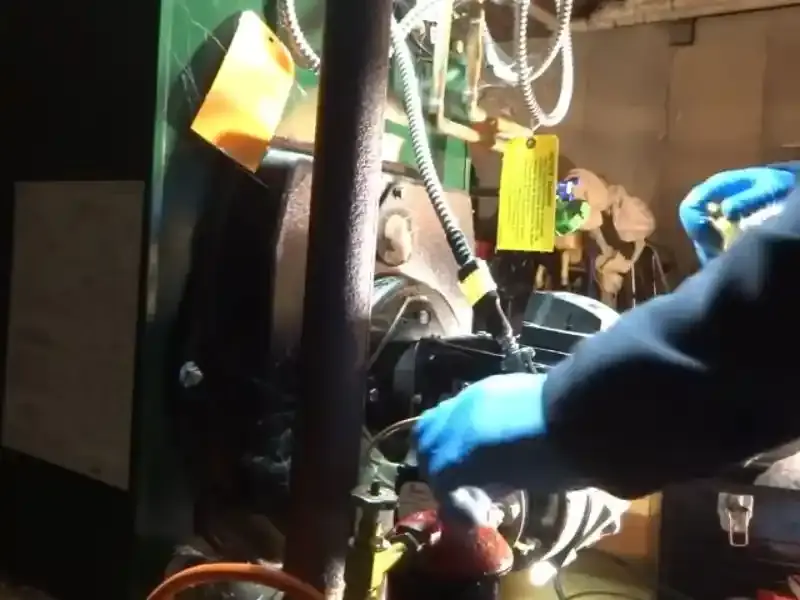
What a boiler does in a New Hampshire house
A boiler heats water, or makes steam, and sends it through pipes to radiators, baseboards or in-floor loops. It is a closed loop, so the same water circulates again and again. Plumbing and heating overlap in the pipes, valves, expansion tank and relief valve.
That overlap is where we can help. The burner, the controls and the combustion are heating work. Leaks, valves, pressure and piping are plumbing.
Problems a plumber can fix
- Leaks from pipes, fittings and valves around the boiler.
- A relief valve that discharges or drips.
- Low pressure from a leak or a failed fill valve.
- A waterlogged or failed expansion tank.
- Corroded isolation valves and shutoffs.
- Connections to a water heater that shares the system.
If a boiler loses pressure often, there is a leak somewhere, and finding it is a leak-detection job as described on our leak detection page.
Problems for a heating technician
A burner that will not light, a cracked heat exchanger, a bad circulator control board or flue gas problems are heating-trade issues. We will not pretend otherwise. Combustion safety matters, and the person who tunes the burner should be the one who works on it.
If you smell gas or a CO alarm sounds, leave, call 911 or your gas utility and do not go back inside. See our installation page for how we handle gas safety on the plumbing side.
Repair or replace
| Factor | Favors repair | Favors replacement |
|---|---|---|
| Age | Under about 15 years | Over about 20 years |
| Fault | A single failed part | Cracked heat exchanger or repeated failures |
| Efficiency | Running well | Fuel bills creeping up |
| Safety | No combustion concerns | Venting or CO issues |
| Leaks | One accessible leak | Corrosion throughout |
A one-off repair makes sense when the rest of the boiler is sound. If you have had repeated service calls, the cost of staying with it grows.
A pre-winter checklist
Before the cold
- 1Check the pressure gauge, which usually reads 12 to 15 psi when cold.
- 2Look for drips and rust at joints and valves.
- 3Bleed radiators that are cold at the top.
- 4Listen for banging or kettling noises.
- 5Have the system serviced before the first hard freeze.
If a pipe in a boiler loop freezes and splits, it needs fast repair, so see burst pipe repair.
Common boiler warning signs
- Radiators that stay cold, or are warm at the bottom and cold at the top.
- Banging, kettling or gurgling sounds.
- Water on the floor near the boiler.
- A pressure gauge that keeps dropping.
- A pilot or burner that goes out repeatedly.
- Rust or white mineral crust on fittings.
Some of these are quick fixes, like bleeding air from a radiator. Others, like repeated pressure loss, point to a leak that needs finding. Write down when each symptom appears and how long it lasts, because a pattern helps whoever diagnoses it.
How to decide who to call
If water is visible, the problem is probably in the plumbing and we can help. If the boiler is not firing, making odd smells or tripping a safety, a heating technician should look at it. If you are unsure, describe what you see when you call. We will tell you whether it is our kind of problem, and we will not take a call that belongs to another trade.
A boiler that fails during a cold snap is urgent. If the house is getting cold and pipes may freeze, shut off water to the exposed lines, open cabinet doors on exterior walls and keep heat moving. Our burst pipe team handles any pipe that splits in the meantime.
Keeping a boiler loop healthy
A closed hydronic loop should hold steady pressure. Frequent top-ups of fresh water introduce oxygen, which corrodes iron components and leads to sludge. If you must add water more than a couple of times a season, there is a leak or a failing part, and fixing it protects the whole system.
Check the expansion tank, the air vents and the isolation valves each fall. They are inexpensive parts that, when they fail, put stress on everything else. We replace worn valves and tanks and flag anything that needs the heating technician.
Questions to ask a technician before you approve work
Ask these
- 1What exactly failed, and can I see it?
- 2Is this a repair or a sign the boiler is near the end?
- 3What is the price for the repair and for replacement?
- 4How long should the repair last?
- 5Does the work need a permit, and who arranges it?
A good technician answers each of these plainly. If you get vague answers or pressure to replace without a reason, get a second opinion. A boiler is a major cost, and a one-off repair on a sound system is often the right call, while an old boiler with repeated failures is not worth another patch.
Local note for Concord homes
A long heating season
Concord's January mean low is about 12.9 degrees Fahrenheit and the city averages 67.7 inches of snow a year. A boiler runs hard here, for many months, so a failure often shows up during the coldest week.
The city's Building Safety Division at 41 Green Street has a Plumbing and Mechanical Inspector, and plumbing inspections are scheduled by the licensed contractor. If a repair involves new piping or a replacement boiler, ask whether a permit applies. Homes in Hopkinton and Loudon, which are often farther from town, face the same cold. See Hopkinton and Loudon.
Questions homeowners ask
A plumber can fix leaks, valves, pressure problems and the expansion tank. Burner and combustion issues belong to a heating technician.
A leak somewhere in the loop, a failed fill valve or a failed expansion tank. Finding the cause is the first step.
When it is old, has a cracked heat exchanger or has repeated failures. A single failed part on a sound boiler is usually worth repairing.
Still have a question about your situation? Call the 24/7 line and talk it through with a dispatcher.
Call (603) 815-9179Sources. According to the following: January low and snowfall are from the City of Concord's climate data, and the Plumbing and Mechanical Inspector role is from the Building Safety Division.