
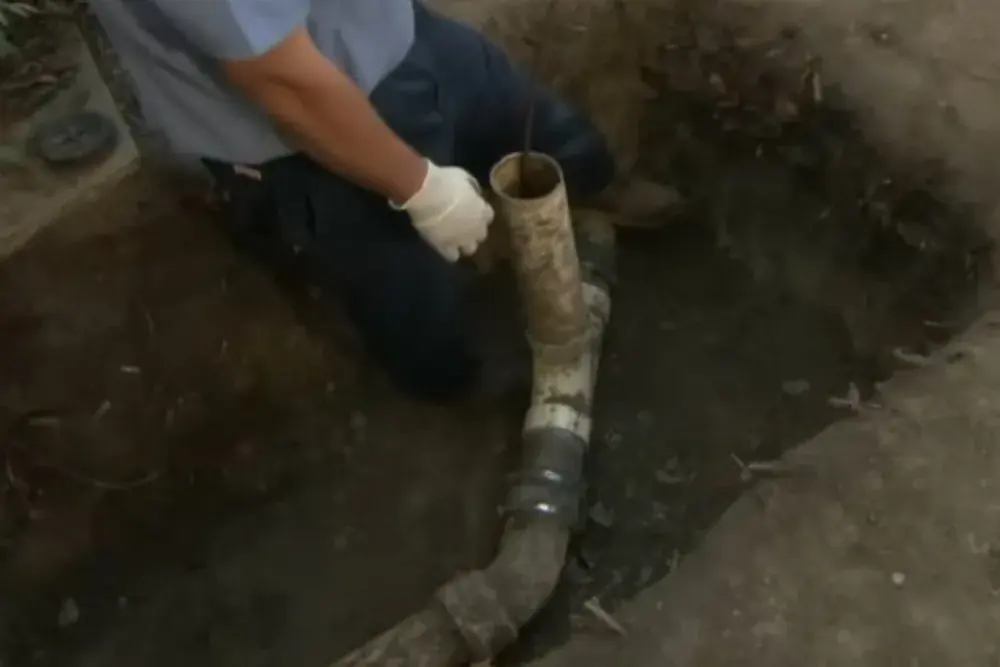
Signs the line is broken, not just clogged
A clog clears when cleaned. A broken line comes back. Repeat backups after cleaning, sewage smell in the yard, a wet or sunken patch over the pipe path, sewer gas in the basement and slow drains throughout the house all suggest damage.
If you have an emergency, such as sewage on the floor, we will clear the line first to get the house usable and then camera it to see what failed. You do not have to decide on a repair while standing in a flooded basement.
What a camera shows
A sewer camera on a push cable shows cracks, offsets, roots, belly sags and collapsed sections, along with the depth and distance from the cleanout. A locator on the surface marks the spot so a repair can be targeted rather than guessed.
We show you the video and explain what you are seeing. For a standalone planned inspection, see our sewer inspection page.
Repair options: dig, line or replace
| Option | Best when | Trade-off |
|---|---|---|
| Spot repair by excavation | One short damaged section | Digs a hole at the break, restoration needed |
| Pipe lining (cured-in-place) | Cracked or rooted pipe that is still round | Cannot fix a collapsed or badly offset pipe |
| Pipe bursting | Full replacement with less digging | Needs entry and exit pits |
| Full replacement by trench | Collapsed or failed pipe throughout | Most disruption, longest lifespan |
Lining and bursting are called trenchless methods because they avoid a long open trench. They are not always possible, and we tell you which options your pipe allows.
Sewer Line Repair help is one call away, any hour of the day.
Call (603) 815-9179Cast iron and clay pipe in older homes
Cast iron pipe was standard in many older houses. It corrodes from the inside, forms rough scale, and eventually cracks or flakes through. Clay pipe has joints that roots find easily. Orangeburg, a tarred fiber pipe, sags and collapses with age.
For a cast iron pipe with a single crack, a repair sleeve or short section replacement can fix it. If the whole pipe has scaled and thinned, replacement is the lasting answer.
Digging in Concord: frost, utilities and permits
Concord's frost depth is 48 inches, so a lateral laid shallower than that, as some older ones are, can freeze in a hard winter. We check depth during the camera run.
Before any dig, we call 811, the free utility locating service required in New Hampshire. Work in the public right-of-way involves the city. The city's Building Safety Division at 41 Green Street handles permits, and plumbing inspections are scheduled by the licensed contractor, so that step is ours to manage.
What drives the cost
- Depth and length. A deeper pipe or a longer run takes more time and equipment.
- Access. A line under a driveway, patio or garage floor costs more to reach.
- Method. Lining and bursting avoid some restoration costs, but the equipment is specialized.
- Pipe material and condition. Cast iron and clay can need more repair than plastic.
- Restoration. Landscaping, concrete and paving repair are separate from the plumbing.
We give you the price before work starts, with the options side by side.
After the repair
What to do while you wait for the repair
- 1Stop running water in the house.
- 2Keep people and pets away from any sewage.
- 3Do not use chemical drain cleaners.
- 4Photograph the damage for your records.
- 5Wear gloves and boots if you must clean up spills.
When the new pipe or liner is in, we camera it again to confirm the repair holds and the line drains. You get the before and after video, and we note the depth and material for your records. If the repair involved an excavation, we backfill and compact the trench, and surface restoration such as landscaping or paving is handled separately.
Sewer repair questions
Yes. We take sewer calls 24/7. We clear the line first to restore service, then camera it to plan the repair.
Repeated backups, a sagging yard over the pipe and a camera that cannot pass a section are the signs. A camera inspection confirms it.
No. A pipe that has collapsed or is badly offset usually needs excavation. We use the camera to tell you which options fit.
The section under the street connects to the city main. For that part, report it to Concord General Services and we can document what the camera shows.
Still have a question about your situation? Call the 24/7 line and talk it through with a dispatcher.
Call (603) 815-9179Sources. According to the following: Frost depth of 48 inches is from the City of Concord's structural loads guidance. 811 is described by the New Hampshire Department of Energy, and permit steps by the Building Safety Division.