
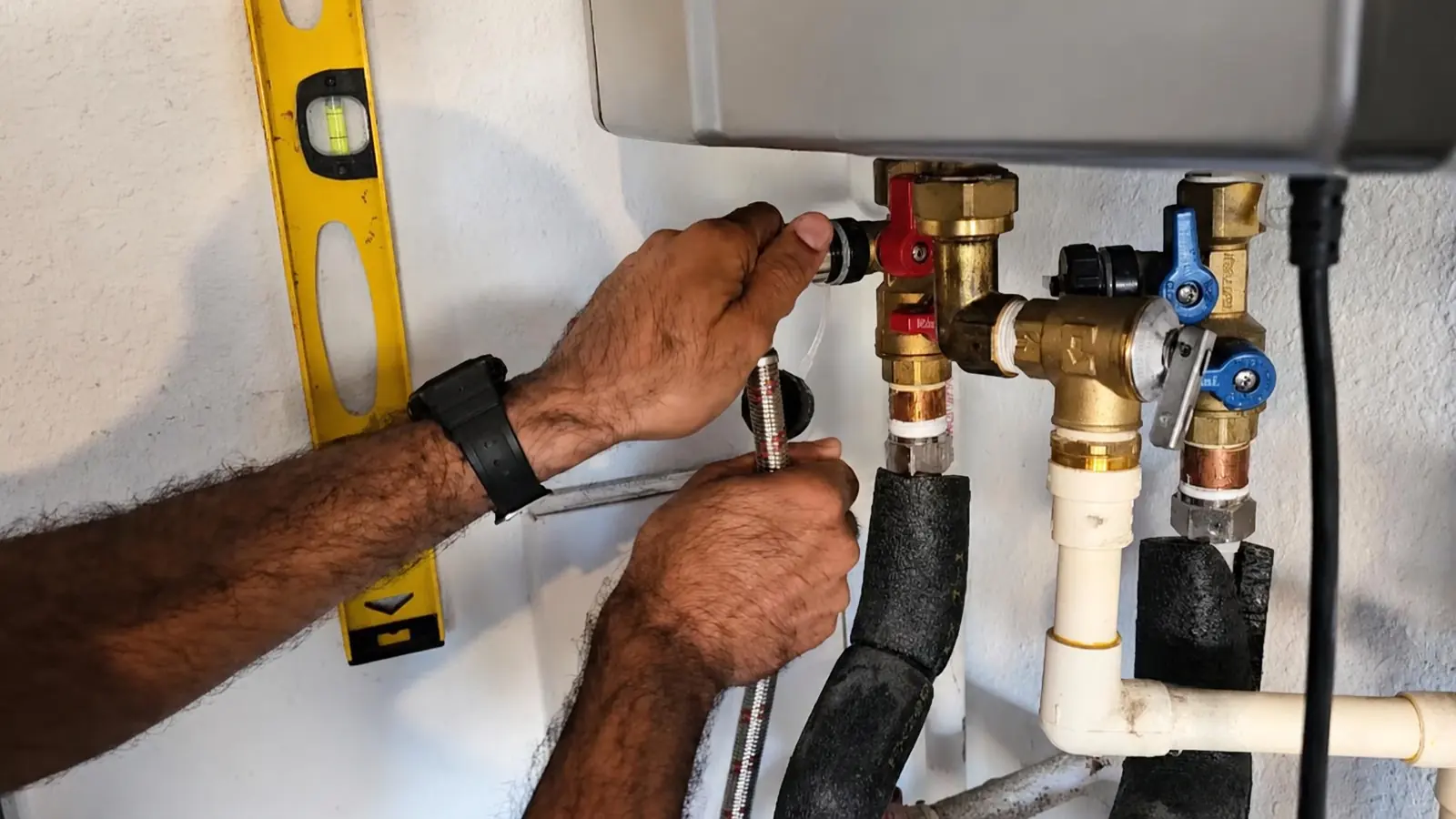
How tankless heaters work, and where they fall short
When you open a hot tap, a flow sensor fires a gas burner or electric element that heats the water passing through a heat exchanger. There is no tank to lose heat when nobody is home, which is the source of the savings. The catch is flow. A unit can only heat so many gallons per minute by a set temperature rise.
In winter, groundwater is colder, so the same unit delivers less hot water than in summer. A heater that is fine in July may struggle in February when several fixtures run at once. Sizing for the worst case is the single most important decision.
Gas or electric tankless
| Fuel | Strength | Requirement |
|---|---|---|
| Natural gas | Highest flow, most common | Larger gas line, venting, condensate drain |
| Propane | Same flow as gas | Propane supply sized correctly |
| Electric | Compact, no venting | Heavy electrical service, often limited flow |
Electric tankless units draw so much power that many houses need a new panel or a heavier feed. We check before we quote. If your panel cannot carry the load, gas or a hybrid tank may be the better path, as covered on our installation page.
Flushing and descaling a tankless unit
Minerals in the water build up inside the heat exchanger and narrow the passages. The result is lower flow, error codes, noise and shutdowns. Flushing with a descaling solution through isolation valves dissolves the scale and restores flow.
Concord's treated water is soft, with 2022 hardness near 12 parts per million, so scale builds slowly here. Homes on private wells in nearby towns, where hardness can be much higher, may need a flush more often. We tell you the interval that fits your water, instead of a generic yearly schedule.
Isolation valves make flushing quick. If your unit lacks them, we add them during the first service, which turns every later flush into a short visit.
Tankless Water Heater Installation, Repair and Flush help is one call away, any hour of the day.
Call (603) 815-9179Tankless repair: the usual suspects
Most tankless problems fall into a few groups. Error codes for ignition, flame or exhaust point to gas supply, venting or a dirty sensor. Cold-water sandwiches, where hot water briefly turns cold, come from low flow or a sensor issue. A unit that shuts off at low flow needs its minimum flow threshold checked, and sometimes an aerator cleaned.
If the heat exchanger has cracked or the unit is well past its life, replacement is cleaner than repair. A planned swap beats a no-hot-water emergency, though for a broken unit our repair team is on call 24/7.
What it costs and whether it pays back
Tankless units cost more to buy and more to install than a tank, because of gas line, venting and sometimes electrical upgrades. Savings come from not heating a stored tank, and for most households they accumulate slowly over many years. They make the most sense where space is tight, demand is steady or you plan to stay long term.
- Gas line size. A tankless unit needs more gas volume than a tank, and a larger line adds cost.
- Venting. Condensing units use plastic vent pipe, and runs through walls add labor.
- Water quality. A water softener or scale filter in hard-water areas protects the heat exchanger.
- Recirculation. A recirculation pump adds comfort at the farthest fixture and adds installation cost.
Before you decide
Ask yourself
- 1How many fixtures run at the same time?
- 2Is there room for a larger gas line?
- 3Will the unit be outdoors, where freezing is a risk, or inside?
- 4Do I plan to stay in the house for ten years or more?
- 5Is my panel ready for an electric unit?
An exterior tankless unit needs freeze protection in New Hampshire. Most outdoor-rated models include built-in heaters, but a power outage during a cold snap can still be a risk, which we discuss before installing.
Tankless questions
It depends on water hardness. In Concord's soft water, longer intervals are often fine. On a private well with hard water, once a year is typical.
Not in the tank sense, but it can exceed its flow limit if too many fixtures run at once.
Yes. We check gas line capacity, venting and electrical needs first.
Yes. We repair and flush most common brands, and tell you when replacement is the better call.
Still have a question about your situation? Call the 24/7 line and talk it through with a dispatcher.
Call (603) 815-9179Sources. According to the following: Concord hardness (2022) is from the city's Water Quality Report. Winter inlet temperature and frost points are from the city's published climate data.