
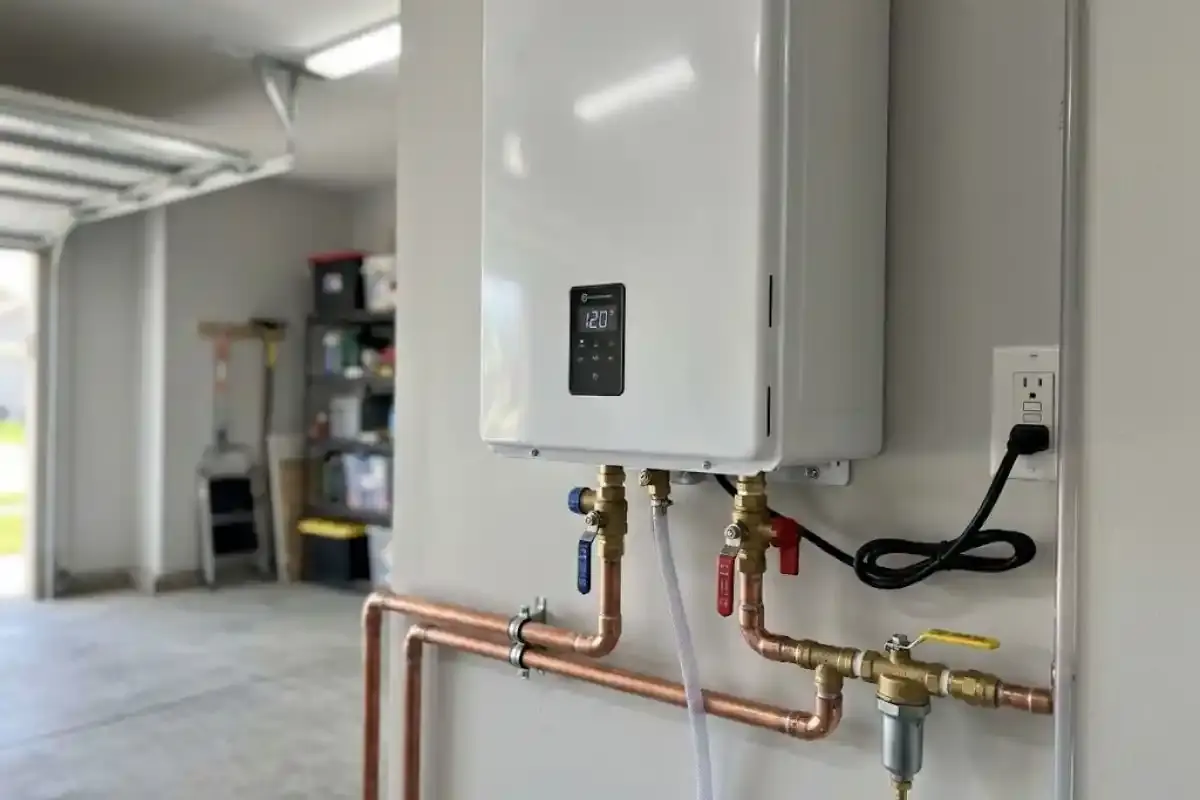
Why people choose an outdoor unit
An outdoor tankless heater vents directly outside, so there is no flue to run through the house. It saves closet or basement space and keeps combustion away from living areas. It is a common choice when a house has no good vent path, or when the old tank sat in a spot needed for something else.
The downside is exposure. Rain, snow, wind and cold all hit the unit, and in New Hampshire, the cold decides the result.
Freeze protection
Outdoor-rated tankless units have built-in freeze protection, usually electric heaters that warm the water lines when temperatures drop. They only work when the unit has power. A storm that takes out power during a deep freeze can leave the unit with no protection, and a frozen heat exchanger can crack.
Ask whether the unit has a drain-down feature, whether you want a backup power source and how the supply lines to the unit are insulated. Pipes running to and from the unit are the weak points, not the unit itself.
| Part | Risk | Protection |
|---|---|---|
| Heat exchanger | Cracking if frozen | Built-in heaters, power supply |
| Supply and return lines | Splitting | Heat tape and insulation |
| Condensate drain | Freezing and blocking | Heated drain line or routing indoors |
| Vent terminal | Snow and ice blockage | Clearance above snow line |
Snow, wind and placement
The unit must sit high enough that snow does not bury the vent or intake. Roof snow can slide onto a unit under an eave, so placement under a roofline needs thought. Clearances for vents, windows and doors are set by the manufacturer and the code, so ask us about the placement before buying.
Wind can also affect combustion and blow cold air across the unit. A location sheltered from the prevailing wind helps.
Gas and electrical needs
A gas tankless unit needs a larger gas line than most tank heaters, and a nearby outlet for its controls and freeze protection. Many houses need a gas line upgrade, which adds cost. Electric tankless units draw heavy current and rarely suit exterior use in cold climates.
If the unit is running on propane, the tank and regulator need to supply enough volume at low temperatures. Ask your propane supplier. See our installation page for how we size gas piping.
Indoor alternative
A tankless unit inside a garage, basement or utility room avoids most freeze concerns. It needs a direct-vent path through a wall, which is often simpler than people expect. Many Concord homes can take an indoor unit with a short vent run.
Compare both before deciding, and also compare against a hybrid tank. Our water heater replacement page covers that.
Questions to ask before you buy
A buyer's list
- 1Is the unit rated for outdoor use and for what low temperature?
- 2Does it have electric freeze protection, and what is its power draw?
- 3Can it drain down automatically if power fails?
- 4What clearance does it need from windows, doors and the ground?
- 5What is the minimum flow it needs to fire?
- 6Who services it locally, and are parts stocked?
Manufacturers publish the lowest ambient temperature their freeze protection handles. Compare that with New Hampshire's worst cold nights, not the average ones.
Maintenance for an outdoor unit
An outdoor unit needs a yearly look. Check the vent terminal for nests and debris, the intake screen for dirt and the condensate line for ice or blockage. Check the insulation on the pipes that connect to the house, since sun and weather break it down.
Flush the heat exchanger on the schedule your water calls for. Fall is a good time, before the first freeze, so you find any problem while it is still mild. We can set that up with the flush described on our tankless page.
Cost, payback and the honest trade-offs
An outdoor tankless unit saves interior space and removes the indoor vent, but it adds freeze protection, a protected gas line and weatherproofing. Those costs are why an outdoor unit in a cold state rarely pays back as fast as the brochures say. Savings come from not heating stored water, and they accumulate slowly.
Where an outdoor unit makes the most sense is a house with no sensible indoor location, a remodel that needs the closet back or a property where an indoor vent run would be long and complicated. If you have a basement with a short wall path, an indoor unit is usually less trouble and less exposed. We will look at both and give you the real difference in price before you choose.
What a winter power outage means for an outdoor unit
A cold snap and an outage often arrive together. Without power, the electric freeze protection stops, and an exposed heat exchanger can freeze within hours at the lowest temperatures. Know how to drain the unit by hand, where its drain valves are, and how to shut off the water and the gas to it.
If you lose power for a long period in deep cold, drain the unit before it freezes and leave the valves open. Restoring it afterward is a short job when you know the steps, and a major one when the exchanger has split. We can show you the drain-down procedure when we install or service the unit.
Local note for Concord homes
What a Concord winter does to an exterior wall
Concord's average January low is about 12.9 degrees Fahrenheit, the city averages 67.7 inches of snow a year and the minimum frost depth the city uses for footings is 48 inches, according to the city and its climate data. A unit mounted on an exterior wall sees every one of those numbers.
In practice, that means insulating the line, adding heat tape and placing the unit above the snow line and away from roof slides. A freeze that cracks the heat exchanger is a replacement, not a repair. Homes in Hopkinton and Loudon, with longer driveways and more exposed lots, face the same cold. See Hopkinton and Loudon.
Questions homeowners ask
Yes, with an outdoor-rated unit and good freeze protection. A power outage in deep cold is the main risk.
Usually yes, because it avoids exposure. It needs a vent path and a larger gas line.
The city's January mean low is about 12.9 degrees Fahrenheit, and it gets about 67.7 inches of snow a year.
Still have a question about your situation? Call the 24/7 line and talk it through with a dispatcher.
Call (603) 815-9179Sources. According to the following: January low, snowfall and frost depth are from the City of Concord's published climate and structural loads data.