
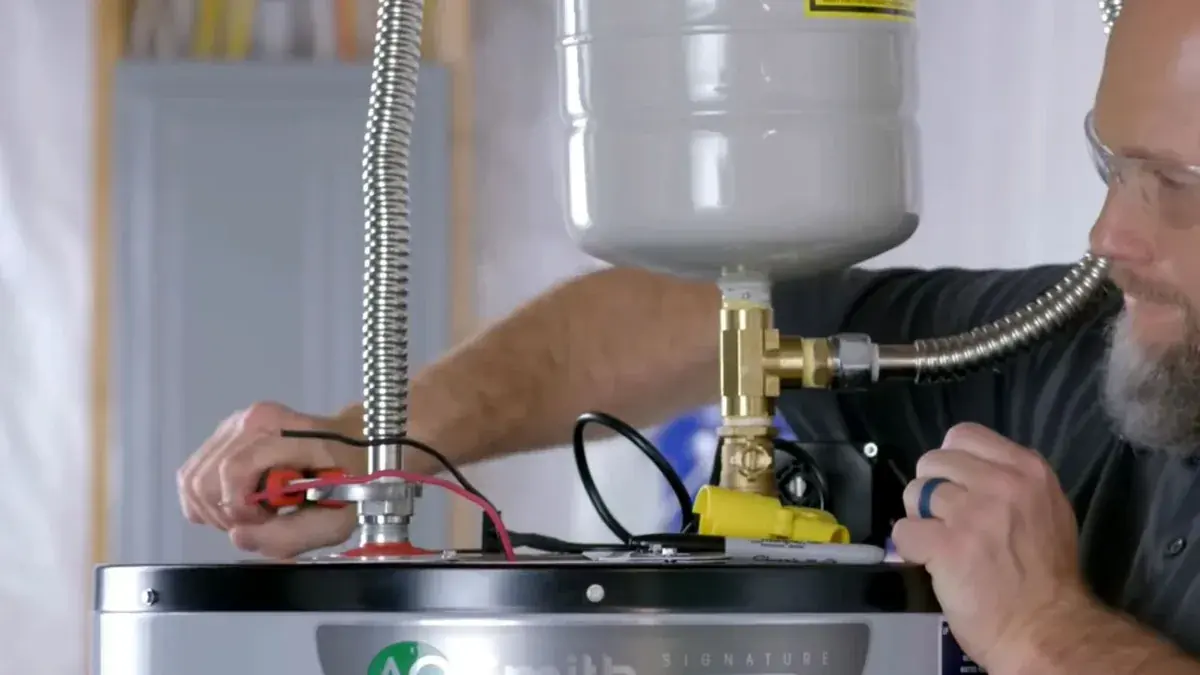
Why water heaters need an expansion tank
Water expands when heated. In an open system, the extra volume pushes back into the street main. If the house has a check valve, a backflow preventer or a pressure-reducing valve, the system is closed and the water has nowhere to go. Pressure spikes, the relief valve opens and the tank and fittings take a beating.
An expansion tank has a rubber diaphragm with an air cushion on one side. As water expands, it pushes against the diaphragm and the air compresses. The tank must be matched to the house's water pressure and the heater's size.
Signs the tank has failed
- The relief valve drips or discharges after hot water use.
- Pipes bang or shudder when a faucet shuts off.
- Water pressure at fixtures spikes above normal.
- The expansion tank feels heavy and full of water.
- Water drips from the tank's air valve.
A failed diaphragm lets water into the air side, so the tank becomes waterlogged and stops absorbing anything.
How to test it
- Turn off the water heater. Cut power or set gas to pilot.
- Close the cold supply and relieve pressure. Open a hot tap.
- Tap the tank. The top should sound hollow, the bottom solid. A tank that sounds solid everywhere is waterlogged.
- Check the air valve. Press the stem. Water coming out means the diaphragm has failed.
- Check the pressure. Use a gauge on the air valve, with the water pressure off. It should match the house pressure.
If you are not comfortable, a plumber can do this in minutes. Our water heater installation page covers the sizing.
Repair or replace
A tank that has lost its air charge can sometimes be recharged with a bicycle pump. A tank with a failed diaphragm cannot be repaired and must be replaced. Replacement is inexpensive compared with the damage a pressure spike does to a heater and its fittings.
When a relief valve has been leaking for months, replace it too. A valve that has dribbled hot water often does not seal again.
What to check before replacing
Checklist
- 1Measure house water pressure with a gauge.
- 2Note whether you have a pressure-reducing valve.
- 3Check whether a backflow preventer was added.
- 4Confirm the heater size.
- 5Inspect the supply connection for corrosion.
Pressure above 80 pounds per square inch is hard on every fixture. If your pressure is that high, a pressure-reducing valve may be the real fix, and our installation team can add one.
Installing or replacing an expansion tank
An expansion tank mounts on the cold water line near the heater, usually with a tee and a short nipple, and hangs vertically with the air valve up or sits on a small support. The tank must be charged to match the house pressure before it goes in, or it will not work. Charging a tank to the wrong pressure is the most common installation mistake.
Water must be off and the line drained before swapping. If the tank is heavy, support it so its weight does not strain the pipe over time. After installing, open the supply, check for leaks and watch the relief valve through a heating cycle.
Pressure: the number that matters
Static water pressure above about 80 pounds per square inch is hard on appliances, valves and the heater itself. A gauge that screws onto a hose bib shows the number in seconds, and a good gauge has a drag needle that records the peak overnight.
If the pressure is high, the cure is a pressure-reducing valve, not a bigger expansion tank. If the pressure is normal and the relief valve still drips, the expansion tank has probably failed. Testing both is the way to tell the two problems apart.
Why a failed expansion tank is easy to miss
A failed tank does not announce itself. It sits on a pipe above the heater, usually out of sight, and the first symptom is a relief valve that drips now and then. Many people replace the valve and the dripping returns a month later, because the real cause was never touched.
The pattern to watch for is dripping that follows hot water use. When the heater cycles on, the water expands, pressure jumps and the relief valve cracks open for a moment. If the drip shows up after showers or laundry and stops after an hour, thermal expansion is the cause, and the expansion tank is the part to check first. Keeping a note of when it drips helps us diagnose it faster.
How long a repair should take and what it should include
Replacing an expansion tank is usually a short visit. We shut off the supply, drain a little water, swap the tank, charge it to match the house pressure and restore water. Then we watch a full heating cycle to confirm the relief valve stays quiet.
A visit should also include a pressure reading, a look at the relief valve and its discharge line and a note about anything else we see on the heater, such as corrosion or an aging anode rod. If a plumber replaces the tank without measuring pressure, ask why. The pressure number is what decides whether the tank is the right fix.
Local note for Concord homes
City water versus a private well
Whether you need an expansion tank depends on how your water arrives. Homes on city water, like those in Concord, are often closed systems if a backflow preventer or pressure-reducing valve was added, and expansion tanks are then common. In Bow, about 90 percent of residents rely on private wells, according to the town.
A well system has a pressure tank that can absorb thermal expansion, so a separate expansion tank may not be needed in the same way. Ask a plumber who has seen the setup. Our Bow page explains how well systems differ, and our Hooksett page covers precinct-supplied homes.
Questions homeowners ask
Not all. A house with a closed system, such as one with a check valve or pressure-reducing valve, usually does.
Often 5 to 10 years, but it varies with pressure and the water. Test it every year or two.
Often not, because the well pressure tank acts as a cushion. A plumber should check the system.
Still have a question about your situation? Call the 24/7 line and talk it through with a dispatcher.
Call (603) 815-9179Sources. According to the following: Private-well share of Bow households is from the Town of Bow's published facts.